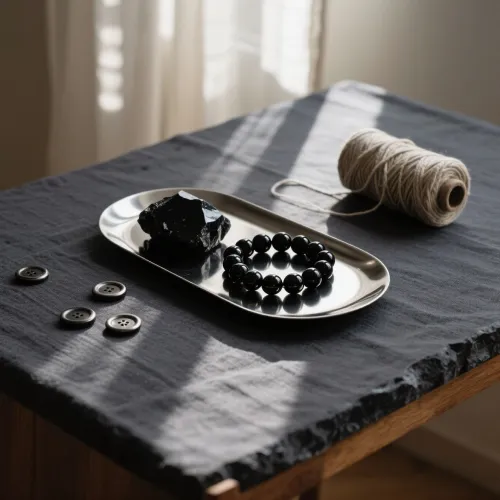
Where Should I Put Obsidian In My House
The ideal placement depends on balancing environmental energy flow with practical living spaces. Focus on entryways for stable integration, living areas for energy harmonization, and bedrooms for tranquility enhancement. Avoid direct electronics proximity while considering natural magnetic variations near walls or corners.
You just brought home that gorgeous piece of obsidian, right? It caught your eye with its deep, velvety darkness – like holding midnight in your palm. Maybe you felt an unexpected pull toward it at the shop, a little nudge from intuition. Well, perhaps not everyone senses that whisper, but there's certainly something captivating about volcanic glass that feels... grounding. And now here you stand, obsidian in hand, wondering where it belongs in your space. Does it go by your laptop where you work? Bedside table? That slightly chaotic entryway? We'll unravel how different spots interact with its natural properties through everyday scenarios you'll recognize. Trust that initial pull you felt – it often knows before your brain processes why.
Explore This Journey Together
Recommended Spots for Obsidian Placement
Ever find yourself instinctively moving that stone around, hoping to "feel" when it’s just right? Entryways carry that first wave of external energy when you step inside – whether muddy shoes or work stress.
Many notice how obsidian pieces maintain presence in busy spots without feeling visually disruptive. Think about that small shelf near your front door: positioning here tends to create a grounded transition space. People consistently report a stabilizing effect when placing it within arm's reach of entryways, like on console tables or window ledges beside doors.
Quiet Corners for Reflection
Create tiny sanctuaries where you pause – reading nooks or meditation cushions. Glass tables or floating shelves near these zones allow unobtrusive placement. Many discover this creates pockets of calm without rearranging furniture.
Shared Living Areas
Avoid high-clutter zones. Try centered locations like coffee tables or TV stands where energy converges, not tucked behind photo frames. Its innate ability to adapt visually to diverse decor styles helps it blend whether your aesthetic is minimalist or cozy maximalist.
Impact of Environmental Fields on Effectiveness
Notice electronics humming around your room? Those devices create electromagnetic ripples we unconsciously register as low-grade tension. Placing obsidian directly beside routers or computers might subtly alter how its properties express.
Many find that crystalline formations within obsidian seem to engage more harmoniously when allowing space between stones and gadgets. If you can’t avoid proximity, consider whether an inward-facing position reduces interference near magnetic field sources. Natural variations along structural lines—like where two walls meet—frequently guide intuitive placement choices too.
Practical Tips for Different Home Areas
Picture holding obsidian in different rooms. Does sunlight catch its edges differently in your east-facing kitchen versus your north-facing study? Each space interacts uniquely based on function and energy flow.
Living rooms handle both conversation intensity and relaxation modes, making versatile placement important. Smaller stones cluster well as centering points above fireplaces while maintaining aesthetic flow. For bedrooms, people often choose nightstands without crowding with electronics. Humidity-prone bathrooms? Surface texture might develop a natural patina over time but won’t diminish core integrity – just wipe gently.
Considering Size and Movement
- Large chunks: Work as anchor pieces near furniture legs or baseboards
- Tumbled stones: Naturally gather in bowls near windows to catch light shifts
Obsidian’s inherent resistance to damage means kitchen counters are surprisingly viable despite heavy use – just avoid direct heat exposure near stoves.
User Experiences and Placement Insights
Emma shared how her black obsidian sphere migrated from various surfaces until landing permanently near her home office doorway: "Like a grounding checkpoint before entering tasks." Such anecdotes reveal subtle wisdom.
Many report that consistency matters more than perfection. One user kept obsidian near Wi-Fi routers for weeks before feeling a subtle discord resolved when moving it four feet toward a northeast corner. Why there? It aligned with natural magnetic variations they later learned existed. Others mention long-term placement enhances perceived equilibrium – one couple noticed heightened calm after eight months near their bedroom windowsill.
Assessing Obsidian Quality Through Appearance
Holding obsidian under lamplight reveals clues. Quality obsidian typically shows uniform depth when viewed from different angles, like suspended ink.
Pay attention to translucency at its edges – consistent sheen often signals integrity. Noticeable fractures or bubbles rarely occur in high-quality stones. People frequently mention how even after years on bookshelves exposed to sun cycles, their pieces develop an unassuming matte finish without losing structural resilience. Simply dusting occasionally maintains visual clarity without impacting responsiveness.
Common Visual Signifiers
- Rainbow sheens: Indicates mineral richness rather than flaws
- Surface scratches: Improbable given obsidian's natural resistance
Honor That Quiet Inner Knowing
When deciding placements, notice those split-second pauses when your hand hovers over a spot longer than expected. Sometimes intuition speaks softly before logic articulates why a corner feels "right." Trust such moments. Choosing where to place objects invites harmony between your space and instincts. It can feel like the universe gently aligning with your choices through incremental confirmations – a sense of "fitting" that emerges without force. Embrace experimentation: moving stones mirrors how we all adjust positions countless times before finding our true place.
Geological Background and Key Questions
Q: Does natural location affect obsidian’s interactions after placement?
A: Volcanic origins suggest mineral inclusion patterns vary between regions, meaning two pieces may respond uniquely to identical spots. Experiment guided by your observations matters more than geological origin.
Q: Urban vs rural settings – should placement differ?
A: Denser electromagnetic fields in cities tend to amplify environmental factors. If you feel uncertain, test placements near windows or incorporate more grounding elements like wood or water features to enhance balance.
Q: Are all obsidian forms equal for home placement?
A: Shape matters! Small tumbled stones project energy outward radially, while polished spheres emit in concentric patterns – consider matching form to room layout and desired effect.